Stalwart Asparagus

Asparagus is a real stalwart, evidenced by the times I’ve seen it in road right-of-ways and farm borders.  My first encounter was a clump catching the breeze off Highway 22 that led to my grandmother’s house in Tennessee.  While I thought this lone survivor from an old timer's garden was a fluke, I’ve since seen the frilly fronds on roadsides in Arkansas, North Carolina, Georgia, and Texas.  

 
Asparagus also thrives in the north as seen here at Chanticleer.  

Asparagus also thrives in the north as seen here at Chanticleer.  


They aren’t native.  No, these old landrace plants are relics of yesteryear, markers of some old homestead or the final brush pile containing said homestead.  In these places it has survived abandon and bulldozer and seems to do just fine as the stem slithers under the surface of the ground, gaining a bit more purchase each year. 

The true stem, that is.  Most people call what we eat stems, but the spears are actually called cladodes, modified leaves that resemble a stem.  If you ever want to check, damage the asparagus’s foliage top.  New shoots don’t originate from the fronds as they would from stem tissue.  Instead, they pierce upwards out of the ground from the rhizome.  

These remnants may not be the supped up cultivars we see in seed catalogs today, but they are still delicious.  Asparagus's culinary essence seems to attract all the attention; however, the plants are quite ornamental, an epiphany I had when I saw in our SFA Sprout garden two falls ago asparagus's senescing canary-colored foliage next to blue, bold Rudbeckia maxima.  It was one of those color combinations that gives you pause in the garden and makes you ask, “Why didn’t I think of that?”  The autumn color and the plant's dainty foliage lent to its installation as a see-through structural interest plant in the food prairies on campus last spring.  The leaves on some individuals reached six feet tall before the end of the summer. 

I'm sure I'm not the first to appreciate Asparagus officinalis's texture and color attributes, but I feel like it.  A plant that you can see going 70 mph down the road warrants more use in ornamental plantings.  I don't think I've ever heard of using asparagus as a perennial like I have the tomes on Rudbeckia, Phlox, and Hosta.  I suppose that's because it "only belongs in the kitchen garden."  Rubbish.  

Nestled amongst Bouteloua, Symphyotrichum, Liatris, and more, one might not immediately notice the Asparagus in our plantings.  But, in the fall when the foliage fades gold, it hides no more.  It will hold a light yellow/tan color for the …

Nestled amongst Bouteloua, Symphyotrichum, Liatris, and more, one might not immediately notice the Asparagus in our plantings.  But, in the fall when the foliage fades gold, it hides no more.  It will hold a light yellow/tan color for the rest of the winter.  

 
I didn't even mention the flowers.  While they are no bigger than a rice grain, small pollinators like to jump from blossom to blossom.  The plants are different sexes.  You need a male and a female for fruit set.  The red fruit …

I didn't even mention the flowers.  While they are no bigger than a rice grain, small pollinators like to jump from blossom to blossom.  The plants are different sexes.  You need a male and a female for fruit set.  The red fruit are usually not preferred since they take away energy from the spears, but if you're using the plant for ornamental purposes, have at it!


This week, I planted asparagus into our kitchen garden at the house with the end goal of contrasting the fine-textured foliage with herbs and low-growing perennials.  A few students helped me collect some wild plants (thanks Aries, Jade, and Jevon!).  

Dividing the mature clumps took some finger work.  The rhizome can be separated into smaller pieces.  The five clumps we dug resulted in about 16 propagules, each with solid, off-white roots and a few buds.  Finding the growing buds, which resemble turtle heads just poking out of their shell, was fairly easy since on most specimens the remains of last years foliage were visible.  Broken up, the crowns look like they belong in Animalia, resembling a jellyfish with long tentacles.   

A clump just after excavating

A clump just after excavating

Pulling the rhizome apart

Pulling the rhizome apart

See any turtle heads?  Then you've found the buds!  If you need a hint, one is at the base of this large out-of-focus root in the left corner of the photo.  

See any turtle heads?  Then you've found the buds!  If you need a hint, one is at the base of this large out-of-focus root in the left corner of the photo.  

Planting was a breeze.  One has to go wider than deeper.  I prefer to shovel soil out of the first hole, situate the crown, and then use soil from the next hole to fill the first.  The last hole gets the first soil.  Before watering and mulching, I made sure that the buds on the crowns were visible or close to the surface.

Jellyfish washed up on shore?  Nah, just asparagus crowns ready for planting.

Jellyfish washed up on shore?  Nah, just asparagus crowns ready for planting.

By the end of the summer, they’ll form a swaying, verdant wall enjoyed in our side porch rocking chairs for years to come.  Who knows?  Maybe a century or two from now some other lad will find them and ponder from whence they came, and maybe he or she will enjoy how delectable they are as both a feast for the mouth and the eyes.  


Titanotrichum Or Treat

One of the plants I associate with fall is Titantrichum oldhamii (gold woodland foxglove).   The flowers look like candy corn.  From the outside they are costumed in a bright canary yellow that can rival any sugar maple's foliage, and looking inside the flowers is a smoldering burnt red throat. 

Also, my first encounter with this Gesneriad was in the fall of 2011 with Jon and Adrienne Roethling in Wyatt LeFever's garden in Greensboro, NC.  They had taken me to see his garden on an cool, overcast day and built up his horticultural reputation by saying he was the breeder of the Forsyth daylily series.  The garden certainly did not disappoint.  Before even looking back at photos, I remember a towering Magnolia macrophylla that Wyatt at one point sported a leaf as a temporary umbrella and the surprise of seeing Cylcamen flowering in his lawn.  Some gardeners can't even grow them in garden beds, and here they were in the turf! 

We rounded a corner in his garden and I remember Adrienne commenting to him about how his Titanotrichum was beginning to flower.  To me it looked like a hot-rod colored Digitalis flower.  I added it to my mental plant wish list as we continued to tour his garden. 

 
See? Candy corn.  

See? Candy corn.  


* * *

Seeing it at Wyatt's inspired me to purchase one a little over a year ago, and it's been blooming on my patio in a container for weeks now.  The indeterminate inflorescence keeps elongating and throwing them out. 

 
DSC_0002-LRPS.jpg
 
DSC_0038-LRPS.jpg
 

I haven't always been as impressed with it.  Earlier this year the plant did an odd thing.  It put up an inflorescence that resembled something in the amaranth family.  I was quite confused.  At first I thought it was actually a different plant that had somehow seeded in.  Or, maybe it had not enough energy to fully develop flower buds and needed a few more years before it actually bloomed.

 
DSC_0049-LRPS.jpg
 

However, from my investigations I learned Titanotrichum can actually produce two different types of inflorescences!  Depending on the time of the year, the inflorescence can either sport a shoot that contains thousands of small bulbils for vegetative propagation (much like the little black bulbils on some lily scapes, but smaller) OR it can produce a flowering inflorescence.   The research says the plant produces the bulbil-producing shoot during short days and flowers during long. 

In an inspection of the inflorescence one morning earlier this month, I counted nine flowers blooming and one in bud.  However, this morning it's flowerless.  The inflorescence is continuing to elongate, but I don't see any more yellow flower buds at the top.  So, I assume it's made the switch back since we just started autumn? 

I'll keep a watch on it in future weeks.  Even though this plant tricked me with it's weird inflorescence, it's always a treat to learn about a plant that breaks the mold. 

I Like Showy Evening Primrose

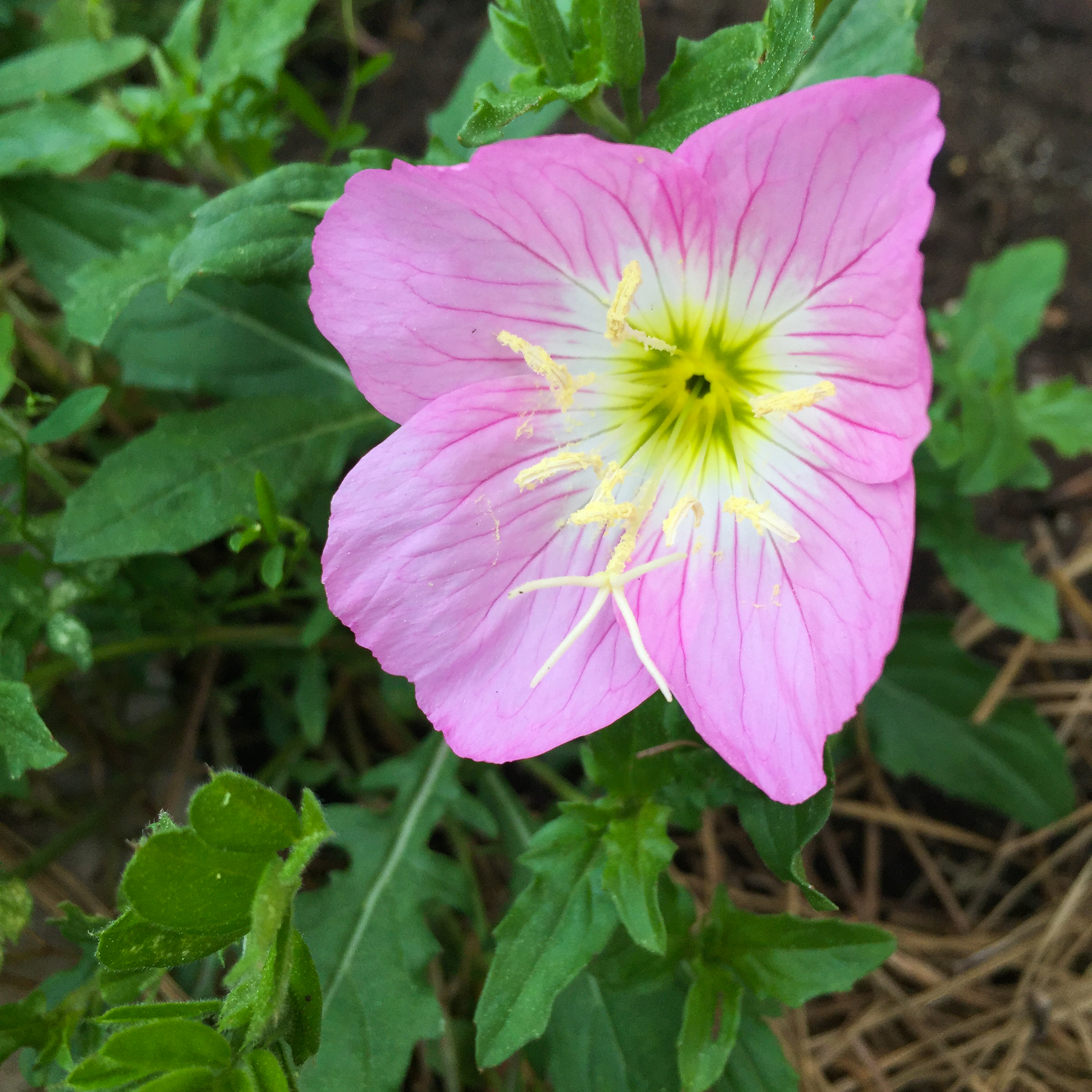
I like showy evening primrose (or, Oenothera speciosa for those of us who are botanically inclined).  I love seeing the cheerful little flowers that dot roadways, and when the petite, pink parasols pop up in the lawn, it brings a smile to my face.  It was actually one of the first wildflowers I ever grew.  I recall buying a pack of seed at the garden center, scattering them in my tiny garden behind our pool, and watching as they quickly came into bloom.  Success in a season.  What gardener doesn't want that?  

But, I didn't realize there was such animosity towards one of my favorite wildflowers until I read Steve Bender's piece "If you value your life and yard, don't plant this."

 
Such a scary thing, huh?

Such a scary thing, huh?


He writes,

If you see pink evening primrose ... for sale at your garden center, I have a single word of advice. RUN. Do not buy. Do not plant. Do not say to yourself, “It’s a native plant, so it must be good.” Do not overlook the fact that any wildflower that can conquer acres of farmland can gulp down your garden in a single sitting...
— Steve Bender

Reading that opinion made me sad.   My biggest qualm with the piece is recommending to thousands of readers to not plant something because it spreads.  He goes on to say, "a pink primrose tsunami swept over my garden the next spring, choking the phlox and drowning the daylilies".  

That's such a boring way to garden!  Plant perennials.  Mulch them in their little cubicles.  Don't let them touch.  Repeat next year.  And, the next.  And, the next.  Ad nauseam.  

I want plants to touch, mingle, grow through each other, and duke it out in the garden.  I want to see ecology in action and for plants to actually live instead of being static chlorophyllic mannequins.  

I'm constantly looking for good groundcovers for southeast mixed plantings, and this native primrose shows such promise for use in mixed plantings.  In Texas, it covers our soil in the winter and reduces erosion, and ours that we grow in the Sprout garden have been blooming now for over three months since March 8th.  Then, come summer it peters out with a reflush of flowers in the fall.  As a bonus for the pollinator groupies out there, research conducted at UT Austin showed honeybees, skippers, and pierid and papilionid butterflies visit the flowers.  

Sure, it's aggressive and seedy as many ruderal species are.  But, in a world covered with mulch, hell strips, and roadsides, I'd rather look at pink flowers.  To tell people to not plant something because it proliferates itself is wrong.  

So, spread the word.  Plants like evening primrose that spread can be a gardener's best friend.  Unless you want to keep mulching...  

The Roadside Flowers

Roads are a lifeblood of civilization.  The veins and arteries that criss-cross our world have provided for our needs, wants, and ambitions for thousands of years.  

To build a road, the landscape must be destroyed and altered.  Wendell Berry writes about these scars on nature in his essay A Native Hill.  He states that "even the most primitive road" is for "haste," and "it's wish is to avoid contact with the landscape."   

But, from the chaos of destruction comes creation as nature covers the wounds with new growth like roadside wildflowers.  In places where fire is now suppressed, bison are dead to trample, and no trespassing signs dot the landscape, roadsides maybe the only places passersby enjoy impressionistic wildflowers, albeit at 70 mph.  These slivers of prairie and meadow are where disturbance occurs on a frequent basis, usually in the form of a mower blade but occasionally there's the rogue smoldering cigarette that will lay waste.  Here, especially in spring, we see color burgeon.  

Ember-colored Gaillardia (firewheel) smolder on the highway shoulders in west Texas

Ember-colored Gaillardia (firewheel) smolder on the highway shoulders in west Texas

Roadside decor.  Oenothera speciosa (showy primrose) and a fire hydrant.

Roadside decor.  Oenothera speciosa (showy primrose) and a fire hydrant.

Phacelia bipinnatifida (purple phacelia) form a river of lilac on the roadsides in the Smokies.  If you pull over and squat amongst the flowers, you'll sniff hints of celery.  

Phacelia bipinnatifida (purple phacelia) form a river of lilac on the roadsides in the Smokies.  If you pull over and squat amongst the flowers, you'll sniff hints of celery.  

Salvia lyrata (lyre-leaf sage) is a common acquaintance to right-of-ways, especially in suburban lawns.

Salvia lyrata (lyre-leaf sage) is a common acquaintance to right-of-ways, especially in suburban lawns.

The lemon yellow flowers of Baptisia sphaerocarpa (yellow wild indigo) are very visible at 70 mph and often warrant a u-turn.  

The lemon yellow flowers of Baptisia sphaerocarpa (yellow wild indigo) are very visible at 70 mph and often warrant a u-turn.  

I like looking at roadside flowers.  These right-of-way gardens are one of the best, most readily available places for people across the world to see a plant community in action.  In fact, the claim has been made that in a fractured nature these areas may be the only refugia for some species here in the US and abroad.  And, while I understand and deeply respect Berry's thoughts about damage to the landscape, to me roadsides are opportunities for contact with the landscape and offer a glimpse at how plants weave themselves together.  

It was looking at a roadside years ago that the epiphany of everything I'd read about how people look to nature to design gardens really struck me.  I've never looked at roadsides the same again.  

I look for patterns in the vegetation as I shuffle back and forth across the countryside.  Some plants cover the ground, some fill for a season, and some rise as icons, towering above the life below.  And, whether the flora are relics of a past age, hitchhikers from trucks, or immigrants seeded in by the transportation department, they are beautiful and make trips zoom by as I enjoy the moving picture.  

Growing up in rural west Tennessee I once thought that the best anti-litter campaign was to plant wildflowers on the side of the road instead of hosing it with weed killer.  I believed if the roadsides were smothered with color wayfaring strangers probably wouldn't litter them with trash.  


Over spring break, Karen and I travelled to the hill country in Texas in search of roadside flowers, specifically Lupinus texensis (bluebonnets). 

The day was perfect for photographs.  Just enough wet stuff was falling that you had to wipe your lens occasionally.  We first saw scattered plants dot the roadsides here and there...

2017-0313-003 Lupinus texensis-2.jpg

and then we found more...

2017-0313-004 Lupinus texensis and Opuntia-2.jpg

AND THEN MORE!

2017-0313-028 Lupinus texensis-2.jpg

I commented to Karen at one point that my soul felt full, overcome with all the beauty.  And, it was right on the roadsides for all to partake.  

Bluebonnet leaves wear a necklace of guttated diamonds.

Bluebonnet leaves wear a necklace of guttated diamonds.

The blur of haste juxaposed with the focus of wildflowers.  

The blur of haste juxaposed with the focus of wildflowers.  

Karen photographing bluebonnets for later drawings.  

Karen photographing bluebonnets for later drawings.  

As you've probably already noticed in some photos, the bluebonnets weren't alone.  Drifts of Castilleja indivisia (Texas Indian paintbrush) also competed for the spotlight.  

*Content sigh*

*Content sigh*

The flowers on Castilleja indivisia were so saturated with color!  Besides the crop, I haven't touched this one with Photoshop.  

The flowers on Castilleja indivisia were so saturated with color!  Besides the crop, I haven't touched this one with Photoshop.  

I noticed time and time again that they occurred in different areas.  Sure, a few rouge plants crossed the lines every now and then, but there were clear demarcations.    Was it from the road department sowing them in different areas?  Varied soil conditions?  Or, parasitism?  I found research after I returned home suggesting that the parasitic Castilleja indivisia grown with Lupinus texensis will produce three times more seed.  Perhaps the paintbrushes weren't just competing for attention.  Perhaps they were stealing it.  

Here you see a family portriat of sorts as some flowers are still young while others are showing their age with faded petals.  No matter how old, they are still beautiful.  

Here you see a family portriat of sorts as some flowers are still young while others are showing their age with faded petals.  No matter how old, they are still beautiful.  

A single peach colored variant in a sea of coral.  

A single peach colored variant in a sea of coral.  

From this trip I realized how much I love Indian paintbrush. I found these more striking than the bluebonnets.  From a distance the Castilleja appear orange, but approaching them I realized that the bracts are really more of a rich salmon (my favorite color!) with verdant bases.  Colors blend at a distance, and I'm sure that's how the orange manifests as the eyes register the two.  


I believe that we can learn from what we see on the roadsides.  Roadsides offer us a great testing ground for vegetation that does well in mixed plantings. We can use what we see and the patterns we observe to design better plantings.  

Nature and city life intersect at this designed plant community at the crossroads of Elizabeth Street and South First Street in Austin, TX.  Note the scattered Lupinus texensis filling in around tussock-type grasses.  

Nature and city life intersect at this designed plant community at the crossroads of Elizabeth Street and South First Street in Austin, TX.  Note the scattered Lupinus texensis filling in around tussock-type grasses.  

And as Bliss Carman penned in his poem that I've shared below, they certainly make life more beautiful and more enjoyable.  

ROADSIDE FLOWERS by Bliss Carman

WE are the roadside flowers,
Straying from garden grounds, —
Lovers of idle hours,
Breakers of ordered bounds.
If only the earth will feed us,
If only the wind be kind,
We blossom for those who need us,
The stragglers left behind.
And lo, the Lord of the Garden,
He makes his sun to rise,
And his rain to fall like pardon
On our dusty paradise.
On us he has laid the duty, —
The task of the wandering breed,—
To better the world with beauty,
Wherever the way may lead.
Who shall inquire of the season,
Or question the wind where it blows?
We blossom and ask no reason.
The Lord of the Garden knows.