• Overview
    • Branching Login
    • Blooming Login
  • blog
  • Podcast
  • Presentations
    • Hi, I'm Jared.
    • Southerly Design
Menu

Meristem

Jared Barnes, Ph.D. | Sharing the Wonder of Plants to Help Gardeners Grow
  • Botanic Bootcamp
    • Overview
    • Branching Login
    • Blooming Login
  • blog
  • Podcast
  • Presentations
  • Jared's Story
    • Hi, I'm Jared.
    • Southerly Design
🌱 Cultivate Clarity in Your Garden

Native Wildflower Seedlings of January

January 14, 2024

It’s a new year, and even though we are mere weeks into winter, I can already see new life has begun to stir in the garden amidst the detritus of the previous season. And, even though much of the garden has gone brownscale, there are sparks of green appearing at the ground level. The verdant threads of Muscari and Ipheion foliage are weaving themselves through the grays, browns, and tans of last year. And, Achillea millefolium (yarrow) clumps are so robust they are throwing up flowers.

I haven’t quite figured out how to reconcile the green with the brown. In some areas, they seem a bit at odds as if the seasons are competing against each other. It is as if spring has sprung, and I haven’t cut things back yet. I debate should I remove or reduce the green in certain areas.

But, greenery I will never remove are my native wildflower seedlings. They tend to be less conspicuous, and I love seeing these little seedlings tucked under, around, and even in other plants. Their time to shine will come later when I need ruderal color for creating layers in the garden while other plants are just getting going.

And, more so this year than any previously I am ecstatic to see the number of seedlings of native annuals that have established themselves in my beds. It seems that encouraging them has payed off.

Lupinus subcarnosus seedlings

Lupinus subcarnosus in bloom

Last year was the first year I had a decent stand of our more wet tolerant Lupinus subcarnosus (sandy-land bluebonnet). I collected what pods I could from the plants in my garden and stored them in a galvanized bucket in the garage. I was surprised one sweltering afternoon months later when the sunlight hit the bucket just right, and I heard a pop, much like a kernel of popcorn popping on the stove. I figured that drying would have already released all the seed by now, but could heat be an additional requirement? I sat the bucket on the pavement and moments later I heard pop, pop, pop! Seemed so.

Later in autumn a few hours before a good rainstorm, I separated the chaff and scattered it around wilder parts of the patch I don’t get to weed much in case there were some seed I missed. The seed left in the bucket I scarified by pouring boiling water over them. Once the water cooled, I scattered the the swollen brown specks around the garden right before the rain began to fall. I saw nothing at first, but as autumn deepened I started noticing their characteristic cotyledons appearing in the open spots.

I wasn’t able to get my hands on all the pods. A number of them went rogue and sowed themselves into driveway cracks and mulched pathways near the garden. I can’t do much with those in the drive, but those in the path I have been slowly relocating with a sharp garden knife so I don’t disturb the taproot too much.

Steptanthus maculatus seedling

Steptanthus maculatus in flower

I did something similar with Steptanthus maculatus (clasping jewelweed). I collected what seed I could in a box, and then I went around beating the leftover stalks around the blackberries trellises to release what seed I missed. I probably looked like I was doing some ancient seance to any passers by, but nope, I was just sowing seed. And, now their jagged plum rosettes have germinated and gotten quite large this winter. They seem to like germinating in organic matter since they abhor our acidic soils.

Nemophila phacelioides seedlings

Nemophila phacelioides in flower

But, then there were other wildflowers I didn’t even know were increasing in number. I was stunned to pull back a curtain of Muhlenbergia capillaris (pink muhly grass) foliage to find a clump of around 40 seedlings in a bed clustered together that I didn’t quite recognize at first. Then, when I looked at the lobed foliage I knew they were Nemophila phacelioides, and their proximity to the original clump helped me id them. I now had many to transplant around the garden to encourage their spread. I moved a good number of them in December during a good warm wet stretch, and they have settled in well, their tentacle-like leaves stretching out to capture the warming sun.

But, I shall wait to move any more seedlings until after next week’s cold snap. I like to see at least two weeks of not too harsh weather when moving little seedlings in the winter time. That way I give them the best chance at success so that in Januarys to come I’ll continue to see the beds littered with seedlings once more.


Learn from these similar posts
Featured
The Season of Sowvember
2025-0306-0209 Scutellaria integrifolia seedling-save4web.jpg
Autumn Sowings and Spring Seedlings
Native Wildflower Seedlings of January
Streptanthus maculatus | clasping jewelflower
In ephemera farm, plant propagation

Late April at Ephemera Farm

May 21, 2023

The spring plantings here at Ephemera Farm are the best they’ve ever looked. The perennials have matured, and the matrix species have knitted together. Even though the Baptisia alba took a hit from the freeze we had, their lack of floral dominance has allowed other species to shine.

I call this first area I’ve developed the light beds for the way that the sunlight interacts with it throughout the day. There’s so many opportunities to see magic from the dew glistening from sunrise to the warmth of the last rays as the sun sets below the tree line.

There are three beds near the house totaling approximately 1,300 square feet with two mulched pathways leading through them away from the house. Where two beds are now turf grass and an old satellite pole occupied the spot when we moved in. I treated the beds as independent at first and a holding ground for species that I had been carrying around in pots for a while. But, they felt too disjunct. Therefore, I killed the grass pathways in between, made them more narrow, and mulched them with hardwood bark to make them feel more cohesive.

And, I unified them with color. I was inspired by the native wildflower color palette I’ve seen on our roadsides, and used species that feature pink, purple, blue, red, and white, and variations on those hues. I decided for these beds to primarily keep the yellows and oranges out. I would say that 90% of the species in the beds are natives.

I’ve used mulch to make things tidier. I realized that mulch is a bit like Powerpoint or a hammer, a tool that if overused can make things look terrible, but when used with good technique could be an ally. A thin layer and the matrix species like Carex and Sporobolus knitting together has helped keep the weed pressure at bay.

Enjoy these photos from the light beds in late April.

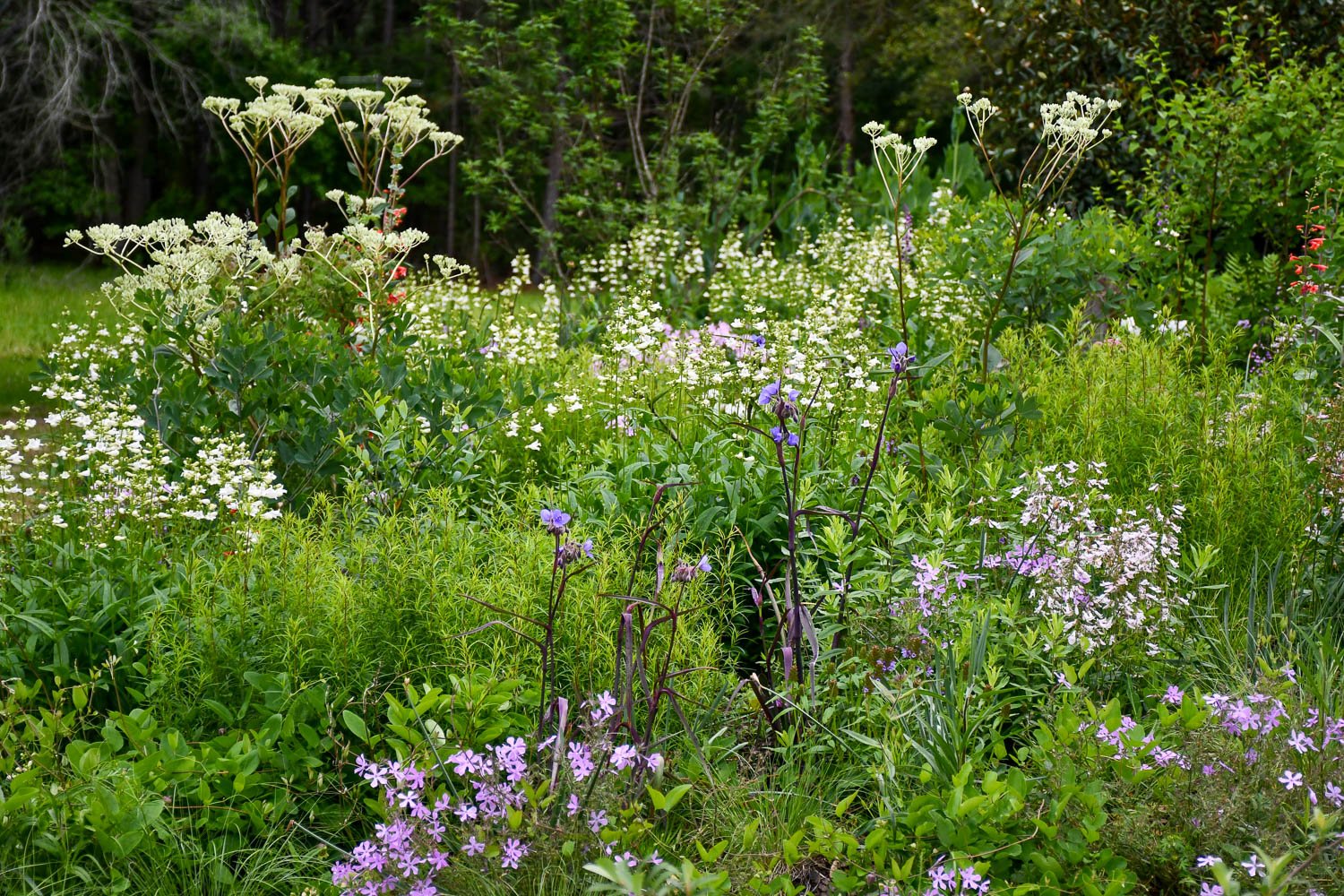
I love pausing at these photos and thinking about where does the eye go? This photo was taken on April 23, and the Penstemon digitalis (foxglove beardtongue) had just started blooming.

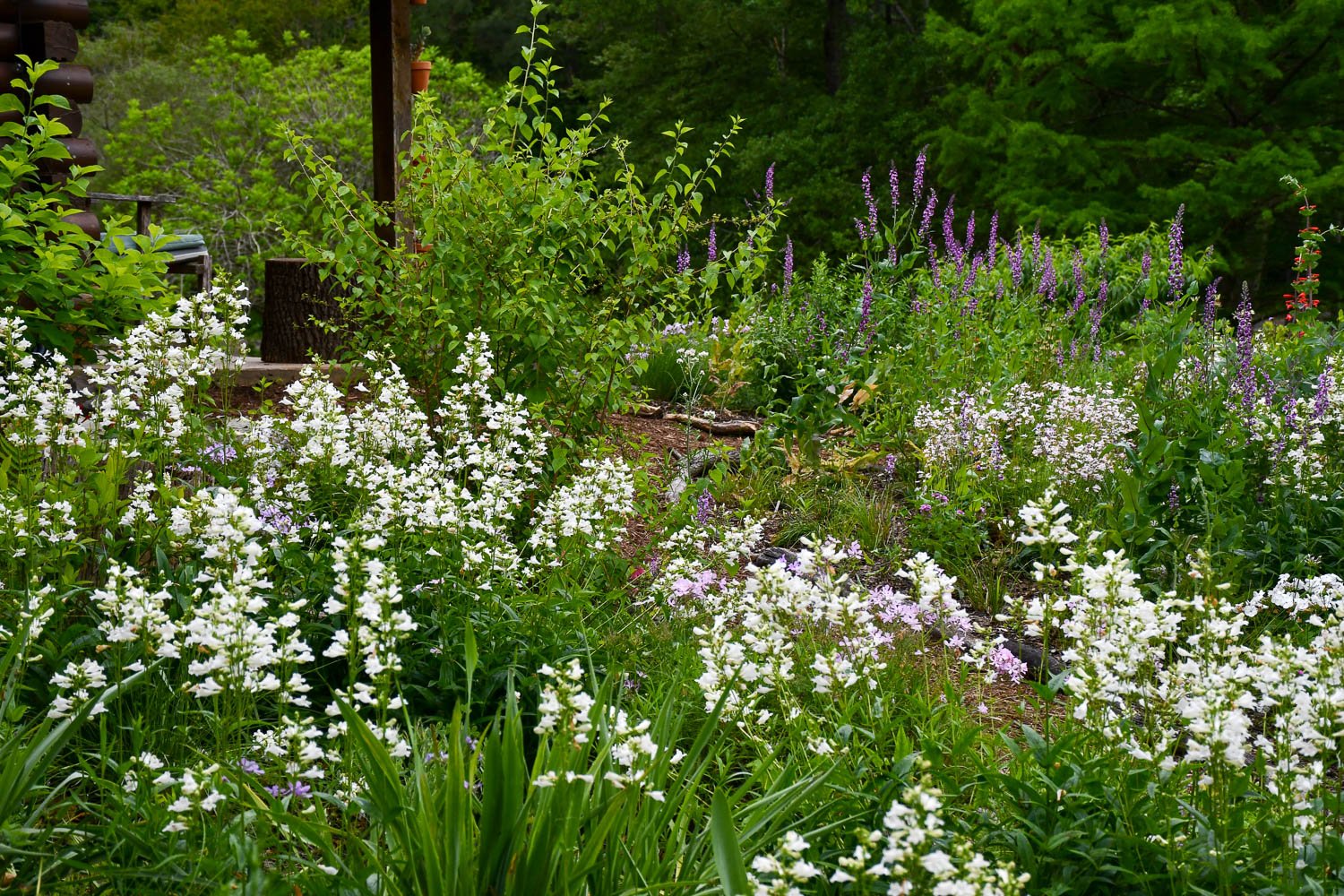
But, six days later on April 29, Penstemon digitalis was in full bloom creating a frothy effect in the planting.

A little further into the beds gives a different perspective. The matured Magnolia laevifolia on the right helps to hide the air conditioner.

The light beds, looking toward the house. I use fallen branches found on the property to line the bed edges.

I primarily grow Rudbeckia maxima (giant coneflower) in the back of this bed for the glaucous foliage.

Looking west the beds continue to effervesce with Penstemon digitalis.

I love how the purple Streptanthus maculatus (clasping jewelflower) rises out of the bed in the background.

Emergents like Arnoglossum plantagineum (prairie Indian plantain) and Penstemon murrayanus (scarlet beardtongue) add another dimension to the planting by occupying the upper layer.

Penstemon murrayanus is one of my favorite spring wildflowers. I don’t know of another plant that embues the green, blue, purple, and red side of the color wheel so well.

Ruby-throated Hummingbirds love Penstemon murrayanus as much as I do!

Phlox pilosa ‘Bonnie’s Pink’ (downy phlox) is a great seasonal filler for spring. It is an aggressive spreader, which means that it can quickly fill a spot where it is planted. And, the swallowtails seem to love it more than my wild Phlox pilosa selections.

We found some purple-foliage Tradescantia gigantea (giant spiderwort) in Central Texas a few years ago, and it has grown well in east Texas, usually fading out as summer approaches.

The flowers of Tradescantia gigantea (giant spiderwort) are wide open in the morning and on cloudy days. The darker foliage pops against the green.

Not everything is beloved for the blooms. Here Rhus aromatica (fragrant sumac) provides a verdant splash with a matrix of Carex texensis underneath.


I love the subtle color echoes of the rusted stems of Pycnanthemum tenuifolium (narrow-leaf mountain mint) and Arnoglossum plantagineum.


Penstemon laxiflorus (nodding penstemon) is a reliable source for spring color. I have to give them a haircut before they flower to keep them from lodging. It’s hard to do with flower buds already on the plant, but a late March chop results in later blooms and more compact plants.

Ruby-throated Hummingbirds also love Penstemon digitalis. I enjoy watching them flit around the blooms.

One final sunrise shot as we head into May.

In ephemera farm, naturalistic planting, garden design
← Newer Posts
 

Use the below search bar to learn from my blog.

No results found
GROW YOUR PLANTING SKILLS WITH Dr. Jared
SAY HI.

© 2017–2025 Jared Barnes, Ph.D.  
All rights reserved.  Go grow some plants. #horticultureisawesome