Noel Kingsbury Bio
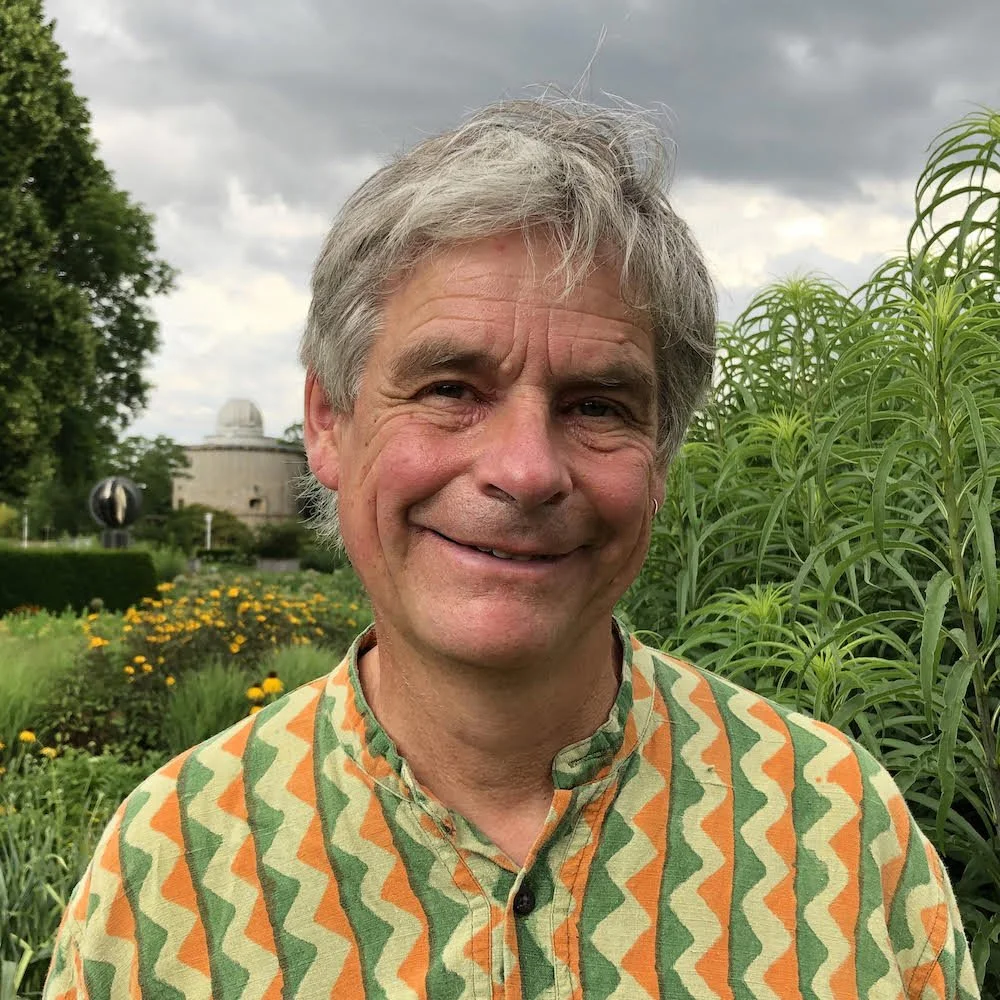
Noel Kingsbury is internationally known as a writer about plants, gardens, and the environment. He does an increasing amount of teaching and lecturing, and is also available as a garden/planting designer and horticultural consultant. Best known for his promotion of what is broadly called an ecological or naturalistic approach to planting design, he has written some 25 books on various aspects of plants and gardens over the years, four of them in collaboration with Dutch designer and plantsman Piet Oudolf. He has also written for Gardens Illustrated, The Daily Telegraph, The Guardian, The Garden, Hortus, The New York Times, and many other publications.
He does planting design and consultancy, mostly for landscape architects working in the public sector, with his main current project being the Queen Elizabeth Garden in London's Regent's Park, as part of the HTA Landscapes team. He is available for private garden work too.
Research is a key part of his approach. In the mid-2000s he undertook PhD research with the Landscape Department at the University of Sheffield, into the ecology and behaviour of ornamental perennials. He has followed this up with further research into questions of long-term performance, all of which he documents at perennialdirectory.org.
He has become increasingly involved in education; his first career was in fact in adult education, and he is passionately interested in improving the way knowledge and skills are communicated within the horticulture and landscape professions. He teaches for Learning with Experts and, with Annie Guilfoyle, runs Garden Masterclass, which runs day workshops throughout the British Isles and since 2020 has built up a major profile as a provider of online education, information, and even entertainment for garden and landscape professionals and keen amateurs. With naturalistic experts, he runs the highly successful Naturalistic Planting Design Course for Garden Masterclass.
In addition to working within horticulture, he is keen that those with an interest in gardens and landscape engage with the world beyond the garden walls — the worlds of art, society, politics, philosophy, economics, and of course the wider natural environment.
You can learn more about Noel at his website www.noelkingsbury.com and gardenmasterclass.org.
SHOW NOTES
How Noel's passion for plants germinated from time spent gardening with his father as a child
1994 as a transformational year — meeting Roberto Burle Marx in Brazil, forming a friendship with James van Sweden in the US, meeting Piet Oudolf in Holland, and discovering the Richard Hansen and the German plant sociology tradition
How visits to German parks opened his eyes to using familiar plants in new ways
The origin of the term "New Perennial Garden"
How the New Perennial movement and a broader revival of interest in perennials happened to converge at the same historical moment
The tangle of overlapping terms — naturalistic, ecological, intermingling, mixed, matrix planting — and why the terminology is still a mess
Distinguishing naturalistic planting (an aesthetic judgment) from ecological planting (tied to site ecology and plant dynamics)
The confusion around matrix planting — an earlier, looser use of the term versus Piet Oudolf's more etymologically accurate concept of a dominant matrix planting with minority species dotted through it
A seven-year planting experiment designed to see which species would eliminate others and accompanying blog post
How that experiment's real lesson was that surviving plants found different ways of occupying space and using underground resources rather than eliminating competitors
Crowd-sourcing a survey on perennial longevity from other gardeners and horticulturists
Why perennial misleadingly implies plants live forever, when some are genetically short-lived and others are highly persistent
American plant ecologists' term conservative plants for long-lived species with major root investment that struggle to return once disturbed
The three root classification categories (rhizophyte, rhizocaulophyte, and caulophyte) and how they predict plant longevity
A newer model from French horticulturist Pascal Prieur classifying shrub branching patterns into acrotony, mesotony, and basitony
Balancing aesthetics and ecology through structure and foliage rather than over-relying on flower color
The black and white test — photographing a planting and converting it to black and white to check whether it still reads as legible and structured
Comparing Denman's (John Brookes' garden) favorably against Great Dixter using the black and white test
Using gradients of moisture, shade, soil quality as a more accurate way to understand habitats than rigid either/or categories
Applying the gradient concept to grasses, from turf-forming/rhizomatous types to tight bunch grasses like Sporobolus and Deschampsia
The origin and purpose of the Perennial Directory (perennialdirectory.org) as a free, evolving resource built from his longevity research
Reflections on Garden Masterclass's range of guests, from well-known designers to working gardeners, nursery people, and social-initiative projects like a women's prison houseplant program
The hardest thing for traditionally trained designers to unlearn is expecting a planting plan to stay fixed rather than letting plants move and fill space over time
Noting that even Piet Oudolf, despite his innovations, still designs in a relatively traditional, fixed-plan way
Thoughts on gardens being not natural
The rewilding experiment at the walled garden at Knepp, and gardener Charlie Harper describing his team as the apex predator making strategic interventions
Larry Weaner's framing of naturalistic management as editing and managing, not maintaining
Core ideas he'd want horticulture students to retain — plant longevity variation, the value of observation, and species-specific self-seeding behavior
The design process behind the Queen Elizabeth II Garden in Regent's Park, including using demolition waste as substrate
Working from structural plants outward to fillers, and planning seasonal color using a spreadsheet
The surprisingly fast three-week design process for that garden
Viewing plants from a rabbit's eye view at ground level to understand root behavior and predict spread
Using roughly nine plants per square meter as a general spacing rule drawn from German and Sheffield practice
A rough 70/30 structural-to-filler ratio, and why humans seem to find groupings of three more satisfying
Strategies for cutting back at the end of the growing season, including a two-stage cutback to deal with wet, windy British winters
His mother Phyllis's career as a successful children's educational book writer, and its possible influence on his own writing
Doing his best thinking while driving or cooking
The value of observation
Busting a gardening myth, the defending targeted, protocol-based use of Roundup against what he sees as unscientific taboo
Wanting a new international agreement to ease plant genetic material exchange across borders, citing the Rio Convention on Biodiversity as an obstacle
Predicting naturalistic planting will trend wilder, more native-species-heavy, and more complex over time
Wanting to see more gardening taught in schools to propagate a love of plants in children
You can learn more about Noel at his website www.noelkingsbury.com and gardenmasterclass.org.
KEEP GROWING