The Avoidance Zone

Don’t you love learning?  Wrestling with a concept, and finally putting the puzzle pieces together to see the bigger picture.  That’s been me lately with this amorphous concept called the avoidance zone.  

Well, longer than lately.  It's been something I've wondered about since childhood, but I didn't know it was called that. 

Growing up in west Tennessee I loved to go romping o'er hill and dale searching for wildflowers.  But, finding any was rare.  I can count on my hands and toes the number of really unique native wildflowers I found within a mile of my house (Erythronium albidum, Trillium recurvatum, and Phlox divaricata near the old creek; Arisaema triphyllum in the woods by the river; and on roadsides and in fencerows Tipularia discolor, Yucca flaccida, Vernonia gigantea, Podophyllum peltatumSedum pulchellumPycnanthemum tenuifolium, and Rudbeckia sp. along with a few other yellow Composite species I never keyed out.  That’s pretty much it. 

I felt so gypped. These books I read showed forest floors and prairies covered with a plethora of plants and blooms as far as the eye could see. Even traveling east towards Nashville you could see Trillium and Geranium going 70 mph on I-40.  I lived in the country.  Rural America.  There should be ample flora for a budding young botanist.  

Why weren’t there more wildflowers in west Tennessee?  It wasn't that we couldn't grow plants.  What flora was there grew very well.  We had fertile soil, and we received abundant rainfall.  I felt I should be finding more.  Go east or west, and the number of different kinds increased.  I assumed the reason why was because the region had been farmed to death.  Fields and pastures now occupied my would-be floral dreamland.  

But, had the species diversity been richer before conventional agriculture arrived on the scene?  I wasn’t certain.  Richer, of course, in a technical sense.  Species richness is an evaluation of how many DIFFERENT types of species are present in an area.

Once in a conversation with one of my undergrad professors Dr. Nancy Baushaus, it arose that the same phenomenon is observed with mammals. The further you go east toward middle Tennessee or the Ozarks westward, the richness of mammals increases.  This observation followed the same trend as what I saw with flora and made sense if we assume that the upper levels of the food pyramid are limited in their richness by the layers of species beneath them.  The pyramids in Egypt don’t get wider as you climb.  

* * *

A few years after I left home for grad school I became aware of the Biota of North America Program (BONAP), a great website for finding county-level distributions of plants species. With that data they help visualize what species occur where, and they can run analysis to see the richness of species diversity in different regions. Browsing the website I discovered this map...
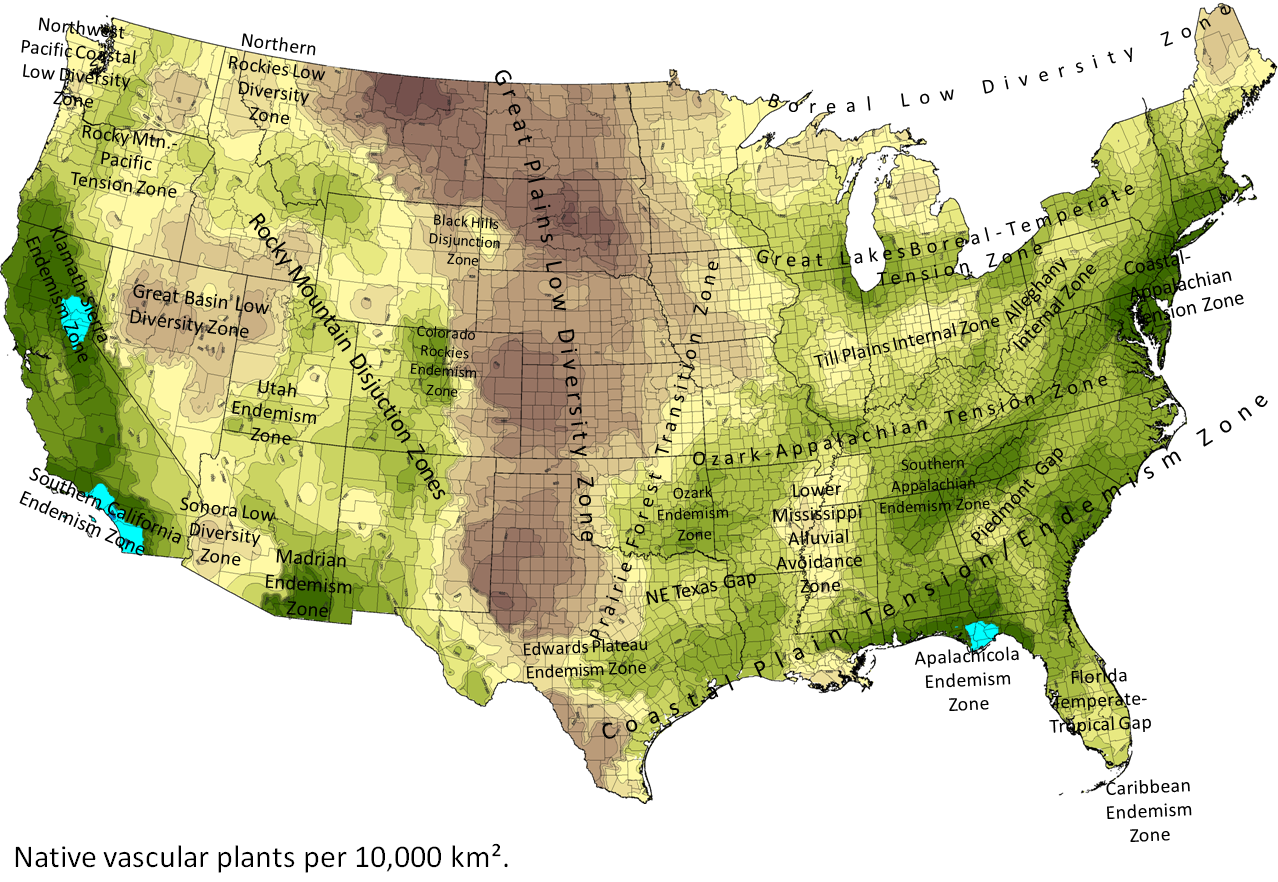
All credit to Biota of North America Program for generating this informative map.  While a legend doesn't exist for the map, green has the highest number of plant species followed by lighter greens and yellow, followed by tans and browns for lo…

All credit to Biota of North America Program for generating this informative map.  While a legend doesn't exist for the map, green has the highest number of plant species followed by lighter greens and yellow, followed by tans and browns for lowest diversity of native vascular plants.  There is more information on the website about the terminology in the map.  

...and that I had been living my childhood in a region called the… dun dun DUN... AVOIDANCE ZONE.  It's like a little yellow desert island in a green sea of vegetation in the south.  Maybe the dearth of wildflowers wasn't my imagination.  Maybe there was something else going on here.  

But, what?  And, what is this thing called an avoidance zone?  The BONAP website states it is where "flora [is] limited by [a] lack of suitable habitat for a diverse flora, whereby widespread species may have a range gap in this area rather than having its own flora.  

The inner first grader in me came out yet again as I asked another why.  Why a gap?!?  There's plenty of resources in west Tennessee, especially with decent soils and ample rainfall.  Years passed as this question sat on the back-burner in my mind, occasionally being stirred from a conversation here and there with a colleague.   

Enter Thomas Rainer.  He turned my mental stove up to high when he presented at Speaking of Gardening in Asheville this past August.  Rainer said during his talk that stresses in a landscape actually increase plant diversity.  

Wait, what?!  Why would stress increase diversity?  It seemed to go contrary to everything that I knew about organisms in their environment.   If environments are too stressful, then hardly anything can grow well.  (*Cough* Antarctica *Cough*)

Several Google searches later with keywords including species and stress and diversity yielded nothing.  But, here is where things got interesting in my thinking.  I flipped the increasing-stress-then-increasing-diversity hypothesis on its head and asked, "If stress increases diversity, could an absence of stress or low stress decrease diversity?"  I.e. better conditions resulting in less types of plants growing in a region.  Perhaps, but again I wanted to find hard evidence why.

* * *

A few weeks ago, I started reading Sowing Beauty by James Hitchmough.  (Side note:  I’m only a few pages into the book.  It’s a great, great read if you want to learn more about how ecology can influence gardening.)

I found the answer!!! 

James wrote that resource-rich environments have low species diversity because the competitor plants present outcompete other species (see my prior post to learn more about the three survival strategies of plants). That’s what they’ve evolved to do, to use resources more efficiently.  And, with their resource-harnessing prowess, they tower over others and crowd them out.   

Mind. Blown.  I think competitor species created the avoidance zone.  West Tennessee habitat is suitable, perhaps too suitable.  I was amazed that it could be not directly due to resource availability or habitat suitability but an indirect effect from some species being resource hogs.  

On a whim, I started looking at factors for plant growth across the country like soil fertility.  The map below was created by Bradley Miller, Randall Schaetzl, and Frank Krist, Jr. (researchers at Michigan State University and United States Forest Service) to illustrate how productive soils are.  Orange soils are less fertile, pink is in between, and purple/blue soils have the highest fertility.

All credit to Bradley Miller, Randall Schaetzl, and Frank Krist, Jr. for their incredible work creating this soil fertility index map.  The link in the caption provides a more detailed legend, but again yellow/orange soils are least fertil…

All credit to Bradley Miller, Randall Schaetzl, and Frank Krist, Jr. for their incredible work creating this soil fertility index map.  The link in the caption provides a more detailed legend, but again yellow/orange soils are least fertile, pink is in between, and purple/blue soils have the highest fertility.

To compare with the original BONAP map, I overlaid the two and created the nifty gif below. 

Avoidance-Zone-gif2.gif

Psychedelic, huh?  While I haven’t done any statistical analysis, it appears that patterns exist between the two maps.  As soil fertility increases (map gradients go from yellow/orange to pink to purple/blue), the species diversity decreases (map gradients go from green to yellow to brown).  A few that popped out to me are listed below.  

  • Orange on the soil fertility map corresponds with green/dark green in the Ozark Endemism Zone, Southern Appalachian Endemism Zone, Apalachicola Endemism Zone, and Coastal Appalachian Tension Zone.

  • Lower Mississippi Alluvial Avoidance Zone (aka home) is pinker in soil fertility than surrounding orange regions and has yellow/tan species diversity compared with the surrounding green/yellow green areas.

  • Great Plains Low Diversity Zone has a blue/purple color for soil fertility and tans and browns for species diversity (notice the orange spot in Nebraska where species diversity actually goes up a little)

Of course, soil fertility won't explain the entire interaction as there are other factors that influence plant growth, and not every part of the map follows the colors exactly.  But, I can see patterns, and this observation helped me answer why we had low species diversity in west Tennessee.   

* * *

The concept that at some point decreasing resource availability and increasing stress species has to result in a drop in diversity still bothered me.  It is just logical, so how do we fit this thinking into a plant community model?

I was looking up some information recently on John Philip Grime who conceptualized the competitor, ruderal, and stress-tolerant model, and I came across his hump-back model of species diversity that really neatly wraps up much of what I've been mulling over since my childhood. 

 
Figures from Michalet, R. and B. Touzard.  2010.  Biotic interactions, biodiversity, and community productivity, p. 59–78. In: Francisco Pugnaire (ed.). Positive Plant Interactions and Community Dynamics.  CRC Pres…

Figures from Michalet, R. and B. Touzard.  2010.  Biotic interactions, biodiversity, and community productivity, p. 59–78. In: Francisco Pugnaire (ed.). Positive Plant Interactions and Community Dynamics.  CRC Press, Boca Raton, FL.


Grime used data he collected from British plant communities to generate the above models.  Curve B is of interest to this post.   Again, species richness is an evaluation of how many DIFFERENT types of species are present in an area.  As environmental stress increases, competitors can't grow as well; therefore, other species that can handle stress can survive.  However, eventually the stress becomes so great that even the stress-tolerant species begin to decrease in number. 

If you'd like to know about Curve A, it represents increasing management/disturbance.  The more frequently plants are killed due to fire, flooding, etc. decreases the competitors so that other plants can grow; this stress increases diversity until the disturbance becomes so great that even the ruderal species decrease in number. 

* * *

So, what’s the application of this?  If I’m a common gardener, what do I care?  

One is a repeat of what many have been writing—stress can be and is an asset in our gardens.  We have a "more" mentality for the resources our plants need like water and fertilizer, but perhaps stressing things a bit would help us be successful with more species. 

I also think understanding this hump-back model can make us better gardeners and designers in combining different species together.  If we have a sense of what survival strategy a species uses, we can make sure that we aren't creating mini-avoidance zones in our gardens.  

Finally, I don't think that the area I grew up in should be called the avoidance zone.  I mean if you were a plant would you want to grow in an area called that?  Kidding aside, yes, the region is a gap between higher species diversity areas, but I don’t think it accurately explains why.  Plants were not avoiding west Tennessee.  They were just being outcompeted.  

2018 Garden Plans

It’s the new year, and we are excited to see the ideas we have for our homestead sprout, grow, and blossom.  I have much I want to accomplish this year, and to really hone my focus, I recently sat down and wrote out my big goals for the new year.  

MAKE A BASE MAP.  Over the holidays I constructed a base map for our smallholding so that we can plot and plan where the different gardens and production areas will go.  Using the survey information, I’ve created in Illustrator a polygon that perfectly fits an underlaid Google map image of our property.  It was amazing for me inputting the shape's criteria only to find that it seamlessly fits our fence rows.  The next goal is to get the trees on the property mapped with their identities.    

FENCE AND PLANT THE ORCHARD.  The orchard has been an area that we have started transforming this fall.  It’s a full sun area with fairly level topography save for a slight rise on the southeast corner.  The area is backed to the north by a haggard fencerow, lined with mature Liquidambar, Juniperus (one of which has absorbed the old, rusted wire), and Quercus.  To this fence row we will attach two perimeter fences about five feet apart to keep out the dastardly deer.  The outer will house brambles and the inner muscadines. Within the inner fence, the long term plan is to plant fruit trees such as persimmons, apples, and peaches and fruit shrubs like blueberries.  While we wait for the woodies to mature, we will be growing edibles and cut flowers in the open areas, which is our current plan for this summer.  There’s been several small trees—random Lagerstroemia and Quercus—to remove before we can plant parts of it, and I’ve already cut down and quartered four of them.  I hope to be ready for planting with fruit trees late this spring, but next fall is more likely.  

EXPAND THE KITCHEN GARDEN.  Our kitchen garden right outside the kitchen door has been a delightful and delicious project this fall, and we will begin expanding it southward to grow more this year.  I need to cut down a spindly red maple that was planted there before we arrived.  It’s too big to move and had very poor color this fall.  I’ve been toying around with the idea of espaliering fences from figs and perhaps other fruit trees.  On the list for growing this year are tomatoes (of course), pole beans, peppers, sweet potatoes, sweet peas, southern peas, and more.  The seed orders are already in progress!  

BUILD A CHICKEN COOP.  Years ago when Karen and I were dating, I hid a book about raising poultry in her Christmas presents as a joke.  We laughed it off, but lately she’s been talking about wanting livestock like chickens.  Perhaps the prank planted a seed!  We both have talked about how they will be good for egg laying and picking pests out of the gardens.  The locals have recommended Black Sex-links.  Building the coop will likely be a summer project.  I’d love to have a mobile one with wheels that we can move throughout the property.  

A PERIMETER OF ANDROPOGON.  It took me a while to decide on what plant should surround our wrap-around porch.  I wanted something showy and attractive but nothing too high to block our view.  When we moved in, giant meatball Camellia and Loropetalum (yes, I know…) blocked the view of the house as well as vistas out our bedroom window.  These have slowly been making their way to the burn pile, save for the Camellia that I want to move to our winter garden.  I iterated through a variety of other options like Hydrangea quercifolia and Carex until finally one day the perfect fit hit me—Andropogon virginicus or broomsedge.  This grass has been a favorite of mine since childhood.  The auric strands in the winter sun look as if Rumpelstiltskin wove them himself.   Sitting on the front porch earlier this year I imagined watching the culms dancing in the wind next autumn in the low sun's vanilla rays and casting shadows on the front porch concrete. The planting will only be about four feet wide, the formal lines lending a modern yet wild look to the log cabin.  The seeds of course will come from local stands up and down the roadsides nearby.  I plan to start cutting sheaves soon before the seeds dislodge.  I imagine also plugging in some early Narcissus and self-sowing bluebonnets for early season color.

OPEN THE GLADE.  As I wrote about in a previous post, east of the house there is a mishmash scattering of woody plants that I want to move to open up the area and create a glade.  It’s a beautiful setting for an outdoor venue for parties and get togethers.  Most of the plants shouldn’t be too hard to relocate. The largest is one of hybrid Magnolia known as "the girls".  I’m not sure which cultivar it is yet, but it will be moved just a short distance to our front shrub border.   

COLLECTING AND PROPAGATING PERENNIALS FOR THE PRAIRIE.  The last big goal of the year is to accumulate and increase the number of perennials for a future prairie installation west of our house, probably in 2019.  An online order here, a stop at Big Bloomers last week in North Carolina there, and I’m well on my way in creating a grassland here in east Texas. 

That's enough to keep me busy for a while.  Good luck to all of you other there pursuing your #lifegoals.  


The Waiting Period

It’s hard.  It's hard to wait for plants to grow.

We want seeds to germinate now.  We want cuttings to root now.  We want fruit trees planted yesterday to bear fruit now.

Our industry spends countless hours and investment trying to short this propagation and growth process.  But, no matter how much research occurs, there will always be a waiting period.

* * *

It’s hard.  It's hard to wait for people to catch the gardening bug. 

We want millennials to garden now.  We want the number of young people that come into our garden centers or horticulture programs to drastically increase now.  We want advertisements and sponsored social media posts from yesterday to bear fruit now.

Our industry spends countless hours and investment trying to shorten this propagation process.  But, no matter how much research occurs, there will always be a waiting period.

* * *

The waiting period.  That's where the magic happens.  You can't always see what's happening beneath the surface, but that doesn't mean that nothing is happening.  It's where dormancy blossoms into life and roots take purchase in the soil, where wonder is imbibed and brown thumbs become green. 

The key is that we keep propagating and cultivating.  Every day do something that will help horticulture grow, plant-wise and people-wise.  Yes, it will take time for results to come from the pipeline, but that's ok. 

We are willing to wait.  

Grasses at the NC Museum of Art

Over Thanksgiving Karen and I trekked to North Carolina, and during our short stay, we found time to swing by the North Carolina Museum of Art museum to see how the grass plantings had matured since the installation. 

The vegetation in the park is an artistic rendering of the North Carolina countryside, and it continued the theme of a piedmont prairie that is used throughout the park from surrounding artwork to use in green infrastructure.  The website says that 150,000 plants were used in the gardens

The grouping of plants was an excellent example of blocking with a heavy focus on grasses.  As a grass groupie, I loved it.  It was very peaceful and tranquil.  In some sections with the elevated mounds and tall grasses I felt separated from the outside world.  I'll let the photos do the rest of the talking.  

This photograph is a before shot from our visit in December 2016.  While I'm not sure of the exact date of planting, my guess is sometime in 2016 based on the small size of the propagules.  

This photograph is a before shot from our visit in December 2016.  While I'm not sure of the exact date of planting, my guess is sometime in 2016 based on the small size of the propagules.  

And, this picture is from our most recent trip.  Grasses galore!  You can make out the ribbonesque block plantings in this image that created a dynamic flow over the landscape.  The lines of plugs have faded away after a year of growt…

And, this picture is from our most recent trip.  Grasses galore!  You can make out the ribbonesque block plantings in this image that created a dynamic flow over the landscape.  The lines of plugs have faded away after a year of growth.  

The juxtaposition of the wild grass with the tame was a legible contrast scattered throughout the park.  

The juxtaposition of the wild grass with the tame was a legible contrast scattered throughout the park.  

Color echo between the wood (what appears to be some type of Carya, I didn't get close enough to look) and the forb (Amsonia hubrichtii).

Color echo between the wood (what appears to be some type of Carya, I didn't get close enough to look) and the forb (Amsonia hubrichtii).

Sporobolus heterolepis skirts the Yucca and really makes it pop better than if it were surrounded with bark mulch.  

Sporobolus heterolepis skirts the Yucca and really makes it pop better than if it were surrounded with bark mulch.  

Not everything had filled in yet.  This river of Amsonia needs a few more years to go from a trickle to a current.  Also, the gray twigs on the left were from Pervoskia.  I wonder how it looks in the growing season as usually this spe…

Not everything had filled in yet.  This river of Amsonia needs a few more years to go from a trickle to a current.  Also, the gray twigs on the left were from Pervoskia.  I wonder how it looks in the growing season as usually this species performs marginally for us in the southeast.  

I liked the use of Eryngium in the planting, but I left feeling like Christopher Walken wanting more cowbell.  I could've used a little more rattle(snake master).  I gotta have more rattle!!!

I liked the use of Eryngium in the planting, but I left feeling like Christopher Walken wanting more cowbell.  I could've used a little more rattle(snake master).  I gotta have more rattle!!!

Some artsy-fartsy shots.  Panciles of Muhlenbergia lindheimeri against an amber sunset. 

Some artsy-fartsy shots.  Panciles of Muhlenbergia lindheimeri against an amber sunset. 

The curls of a fading Amsonia hubrichtii

The curls of a fading Amsonia hubrichtii

Creating a Kitchen Garden

We hadn't lived in the house two weeks before making a kitchen garden, and it's creation has delighted us all fall.

I love edible gardening and have since I was five years old.  For me growing edibles is part of life.  It's just something you do.    

Of all the gardens to create here at our new property, we made it first because we wanted to have food we grow available throughout the fall and winter before growth slowed too much. 

Choosing a location was a no brainer.  We placed it right out the door from the kitchen.  You can see the garden standing at the kitchen sink.  It makes zipping out to get fresh thyme for jambalaya, crisp lettuce for Doritos salad, or a few tomatoes for caprese easy.  Since we see it frequently, we can respond with a quick shot of water from the hose or trellis the leaning tomatoes or rambunctious peas.  The area is currently approximately 20 × 20 ft, but we plan to expand it further down our drive to double our growing area.

Just days after we moved into the house, I ripped out the small, struggling rose collection hugging the driveway and porch, killed the surrounding grass, tilled it with my small Mantis tiller, and aerated the soil using my broadfork.  

Adios, Rosa.

Adios, Rosa.

For the design we created a large central path for access and then divided the beds up on either side with the remaining space. 

Then it was planting time!  *Jazz Hands* We planted cabbage, kale, broccoli, cauliflower, Brussels sprouts, and Chinese cabbage in a diamond pattern in the beds, alternating two-one-two-one.  We planted the north side of each bed with everbunching onions.  And, in the large beds near the garage, cherry tomatoes, lettuce, and peas were planted.  I used 8 ft long 2 × 2's for tomato stakes.  Before the peas went in the ground, I walked around the property collecting straight sticks from some shaggy trees that haven't seen a pruner in some time and fashioned them into a trellis. 

The planted kitchen garden.  I didn't mention the Eragrostis spectabilis in the front left corner, but I found it growing nearby and moved it to the kitchen garden to have a seed source for future projects.

The planted kitchen garden.  I didn't mention the Eragrostis spectabilis in the front left corner, but I found it growing nearby and moved it to the kitchen garden to have a seed source for future projects.

Next to the driveway we also planted some zinnias for late season color as well as herbs like lemon verbena, thyme, horehound, chives, and rosemary.  Some like my chives and rosemary have grown in container culture since 2008, and they have responded quite well to getting their roots in some soil.  Underneath this planting, I sowed 'Magma' mustard seed to provide a post-frost ground cover.  'Magma' is a beautiful two-toned frilly type from Wild Garden Seed.  On the south side of the garden, I scattered some 'Champion' collards seed whose leaves made their way into some bacon grease and brown sugar.

The garden beginning to fill in

The garden beginning to fill in

Zinnias coming into color.  The purple cultviar made a great color companion with the purple cabbage.  I made a note to use them more together in the future.  

Zinnias coming into color.  The purple cultviar made a great color companion with the purple cabbage.  I made a note to use them more together in the future.  

The garden looking quite lush.  I still haven't planted that pot!  

The garden looking quite lush.  I still haven't planted that pot!  

 
I realize that cacophony is about sound, but I also think it a great word to use to describe the mish-mash of color here.  You can see in spots the 'Magma' mustard growing underneath.  

I realize that cacophony is about sound, but I also think it a great word to use to describe the mish-mash of color here.  You can see in spots the 'Magma' mustard growing underneath.  


We haven't faced too many challenges with this garden.  A Yard Enforcer motion sprinkler system has kept the deer away if they ever even got close.  It sent a lightning bolt of adrenaline through me more than once when I forgot whether it was on or off.  Gophers, a new pest I've never faced, have created mounds in the garden, and it's been frustrating to go out and have to clear the soil off young plants.  We had an explosion of cabbage worms once over night, but Dipel has since helped to keep them at bay.  And, an unusually early frost toasted the tomatoes and zapped the tops of the zinnias, but the cool season crops took the cold weather like a champ.

 
First frost, about 3 weeks early

First frost, about 3 weeks early

 
See the frozen guttated pearls on the center leaves?  I live for little moments like these in the garden.

See the frozen guttated pearls on the center leaves?  I live for little moments like these in the garden.

Even with the challenges, it's been a blast growing our own produce, and we are thankful for the new memories and the fresh produce we are harvesting.  I look forward to seeing how this garden evolves from this simple start into a source for year-round food in years to come.  

Mulch Happens

The other night a phrase in The Holistic Orchard by Michael Phillips stopped me reading mid-paragraph.

"Mulch happens."

I was surprised because I feel like horticulture is moving away from wood mulch with the interest in mixed plantings and covering the ground with plants.  Or, at least with that desire in mind (like here and here) if we all aren't quite on board yet. 

The action of mulching just isn't sustainable.  Depending on dead organic matter to prevent weed growth around perennials in place of living plants is a fallacy that will have to constantly be remedied.  It is Sisyphean task.  Hardwood mulch also doesn't naturally occur, except maybe under a fallen, decaying tree.  As Thomas Rainer says, you won't find mulch circles in the forest. 

So, does mulch really happen as Michael wrote?  To make sure that I'm not taking the quote out of context, here it is in full: "Nature builds soil from the top down: Leaves fall, tree limbs decay, mulch happens.    

In the sense that we are used to seeing hardwood mulch strewn across the landscape, no .  We do have an organic layer present in most soils, but it's not a few inches thick of hardwood.   Instead, it's dominated by a mixture of the abscised and the fallen, the green and the brown, the leaf and the stem.  

Michael wrote that when he mentioned mulch he was not talking about recalcitrant hardwood mulch that takes years to decompose.  Instead, he was discussing ramial wood chips, a type of organic matter that comes from branches and stems that are less lignified and higher in nutrients.   He advocated applying these wood chips in random patches throughout the orchard to feed the soil.  His approach is to chop stuff up and then dump piles of it around his fruit trees. They don't form a solid cover, which encourages grasses and other forbs to grow to create a multiculture.  He stated most fruit trees originated along ecosystem edges.  Introducing rough, slowly decomposing organic matter helps to improve the soil similar to these plants' native habitat.  While I haven't studied the use of these ramial wood chips much but want to learn more, the logic behind their use seems sound.  

What I think is fascinating for these perennial cultures—mixed plantings and the use of ramial wood chips in orchards—both schemas ask the question how can we emulate nature and try to enhance the biological systems already in existence, especially with covering the soil.  In both cases mulch happens, just not the way that we traditionally think about mulch. 

Titanotrichum Or Treat

One of the plants I associate with fall is Titantrichum oldhamii (gold woodland foxglove).   The flowers look like candy corn.  From the outside they are costumed in a bright canary yellow that can rival any sugar maple's foliage, and looking inside the flowers is a smoldering burnt red throat. 

Also, my first encounter with this Gesneriad was in the fall of 2011 with Jon and Adrienne Roethling in Wyatt LeFever's garden in Greensboro, NC.  They had taken me to see his garden on an cool, overcast day and built up his horticultural reputation by saying he was the breeder of the Forsyth daylily series.  The garden certainly did not disappoint.  Before even looking back at photos, I remember a towering Magnolia macrophylla that Wyatt at one point sported a leaf as a temporary umbrella and the surprise of seeing Cylcamen flowering in his lawn.  Some gardeners can't even grow them in garden beds, and here they were in the turf! 

We rounded a corner in his garden and I remember Adrienne commenting to him about how his Titanotrichum was beginning to flower.  To me it looked like a hot-rod colored Digitalis flower.  I added it to my mental plant wish list as we continued to tour his garden. 

 
See? Candy corn.  

See? Candy corn.  


* * *

Seeing it at Wyatt's inspired me to purchase one a little over a year ago, and it's been blooming on my patio in a container for weeks now.  The indeterminate inflorescence keeps elongating and throwing them out. 

 
DSC_0002-LRPS.jpg
 
DSC_0038-LRPS.jpg
 

I haven't always been as impressed with it.  Earlier this year the plant did an odd thing.  It put up an inflorescence that resembled something in the amaranth family.  I was quite confused.  At first I thought it was actually a different plant that had somehow seeded in.  Or, maybe it had not enough energy to fully develop flower buds and needed a few more years before it actually bloomed.

 
DSC_0049-LRPS.jpg
 

However, from my investigations I learned Titanotrichum can actually produce two different types of inflorescences!  Depending on the time of the year, the inflorescence can either sport a shoot that contains thousands of small bulbils for vegetative propagation (much like the little black bulbils on some lily scapes, but smaller) OR it can produce a flowering inflorescence.   The research says the plant produces the bulbil-producing shoot during short days and flowers during long. 

In an inspection of the inflorescence one morning earlier this month, I counted nine flowers blooming and one in bud.  However, this morning it's flowerless.  The inflorescence is continuing to elongate, but I don't see any more yellow flower buds at the top.  So, I assume it's made the switch back since we just started autumn? 

I'll keep a watch on it in future weeks.  Even though this plant tricked me with it's weird inflorescence, it's always a treat to learn about a plant that breaks the mold. 

A Frigid Autumnal Fritillary

I love the cool mornings of fall.  They are so invigorating.  Sure, the day may forget that it was ever in the 50's by 2 pm, but I don't.  I revel in them as I'm out and about enjoying this vacation from the heat that's blasted us all summer.  

However, other creatures that depend on ambient temperatures are a bit slower.  

* * *

I remember one of the first cool mornings of fall last year I was out the door before sunrise to enjoy the coolness of the day.  My journal showed it was 54 degrees that morning, and I remember hardly a cloud in the sky.  Brisk and beautiful.

I began tackling my tasks, and inevitably this led to snapping some golden-hour photos.  My subject for the morning was to capture autumn color on my colleague Dawn Stover's ornamental grass collection at SFA.  As I let the shutter fly, a colorful blotch in one of the grasses caught my eye.

"Is that... a BUTTERFLY!?!?" I asked myself quite surprised.  I dashed to get a good photograph as if it were going to fly away, but I needn't rush.  Poor thing couldn't budge since it was so chilly.  It was a Gulf Fritillary. 


I was mesmerized by the idleness.  Butterflies are fleeting moments in the garden, and being able to snap a picture of them is like trying to photograph a ghost.  Yet, here was one frozen in time.  I paused to admire the minutiae that are usually a blur in flight—the autumn-colored regalia, the black-outlined white spots, and the curled proboscis.  

As I walked away, I savored the up close and incredible experience and thought about it being a once in a lifetime encounter.  I began to turn my attention back to the other grasses when I saw a SECOND one!  This time it had fastened itself onto Schizachyrium scoparium 'Standing Ovation' (little bluestem).  


I was really perplexed as I've never seen butterflies roost before, and now I've discovered two in one morning?  A bit of research shows that indeed others have witnessed the phenomenon.  Grasses are a common perch for them overnight, yet another reason to add these stellar perennials to the garden.  

As I walked away, I thought how thankful I am of these chilly mornings that inevitably are winter's pregame.  We all know what comes next—frost and the close of the season.  Therefore, as cooler days descend on us, rise early and look for these little moments that add so much to our gardening life.  


Tendrils from Speaking of Gardening 2017

NorthCarolina-IL.jpg

In August I presented with several other outstanding horticulturists at the Speaking of Gardening Symposium in Asheville, NC.  It was a terrific educational event to attend in the mountains, jam-packed with great ideas and awesome plants.  Below I offer three "tendrils", paraphrased nuggets of knowledge or interesting thoughts that you can really wrap your mind around from each speaker.  


THOMAS RAINER | PLANTING IN A POST WILD WORLD

  1. Planting design in the public sector has to be legible at 45 miles an hour.

  2. With native plants there is so much focus on where they are from but not enough on how to cultivate them.  When people plant things and then see them fail, they get depressed. They blame native plants.

  3. Use tools like plants shape and plant sociability to determine how to combine plants together.  For example, everything about Asclepias tuberosa is an adaptation to where it grows and what it grows with. Deep roots grow through grass roots, and the leaves are able to emerge through shady areas in a prairie.  

ROY DIBLIK | BEYOND THE USUAL: PLANTING THE LURIE GARDEN WITH PIET OUDOLF

  1. When planting the Lurie Garden, I wasn’t accurate.  I stepped it off.  It took a day and a half to do the site. It's not a building; you don’t have to be super accurate.

  2. Teachers come in to help maintain the plantings with students.

  3. They selectively prune the Salvia river at the Lurie Garden.  If you cut Salvia 'May Night' back, it may never bloom again that year.  'Wesuwe' is the fastest rebloomer. If you cut it back, it reblooms in three weeks.

DAN LONG | GROW UP! USING VINES AND CLIMBERS

  1. Clematis need something slender to hang onto.  For other climbers don’t put anchors right up against the wall because the wrappers can't get through that narrow space. Also, being that close to the wall results in low air circulation.

  2. Campsis likes to bloom on horizontal stems or those that droop.

  3. Tropical Aristolochia species can kill pipe vine swallowtail larvae.

PATRICK MCMILLAN | BLURRING THE LINES BETWEEN NATURE AND CULTURE AT THE SOUTH CAROLINA BOTANICAL GARDEN

  1. Every decision we make at the South Carolina Botanic Garden we ask is this good for life.

  2. BOTANICA CAROLINIANA features letters from early explorers like Mark Catesby that have first hand accounts of South Carolina that were written to Britain.  These perspectives help us understand what South Carolina looked like back many years ago and in some cases helps us find where plants were and still are today.

  3. We filmed Ruby-throated Hummingbirds and captured the fastest video footage of them ever. These birds lift themselves because they flap their wings in a figure-eight motion, which generates lift on both the forward and reverse flap.  And, as you can see at the 1:50 mark, they can fly backwards and upside down!

THOMAS RAINER | THE GARDEN OF THE FUTURE: REIMAGINING THE AMERICAN YARD

  1. Turn wall-to-wall carpeting of grass into turf rugs.  The lawn can make the planting look better. It can be a frame to the wilder areas.  Use lawns like a clearing in a meadow.  

  2. Landscape plugs are best for designed plant communities. Most plugs are grown as liners and sold to pot up; thus, liners can dry out fast in the ground.  Deep landscape plugs are longer and deeper.  Make sure that the plugs have good roots.  They can be soaked in buckets or trays before planting. 

  3. Many perennials maintain green rosettes or basal foliage during winter so that winter weeds like chickweed can't grow.

LARRY MELLICHAMP | THE WONDERFUL WORLD OF FERNS

  1. Sensitive fern (Onoclea sensibilis) gets it's name because it is sensitive to freeezing and can burn from cold temperatures.

  2. Ferns can be divided when actively growing.  SUPER IMPORTANT (His emphasis).  Do not disturb the roots and cut off leaves at same time.  You can do either/or but not both.  Broken fronds can still function well.

  3. Lycopodium spores are pyrotechnic!  Light them, and they explode!  The spores were used to make fireworks. 

ROY DIBLIK | THE KNOW MAINTENANCE PERENNIAL GARDEN

  1. First year, install the matrix, and then you keep plugging things in to enhance it over time.

  2. You can wait and plant aggressive plants like Solidago after five years to reduce their competitiveness.

  3. I spray the grass with glyphosate, and then I use a two cycle engine and auger to install the plants into the ground.

Finding a Home

Gardeners are frequently faced with a compelling question—where can I find a home for this new plant I've just purchased on a whim?!  The garden is so full that often no spot can be found. 

I face the opposite problem.  I have thousands of square feet available to me, which in a way creates the paradox of choice.  There are so many places it almost hinders me from planting anything.  Almost.  

My solution has been to put some plants into a holding trial garden to see how they fair in the ground while others are placed in permanent locations.  I'm planting the latter with purpose by citing in favorable growing conditions where they can be enjoyed and will fit my larger overall design scheme.

Edgeworthia papyifera 'Winter Gold' (paper bush) was the first one I wanted in the ground.  I brought it with me from the Pi Alpha Xi plant sale in North Carolina when I moved in July 2014 because it's one of my absolute favorite shrubs, and I was worried I might not find it in Texas.  Why do I like it, you ask?  During the growing season, the large tropicalesque, pubescent leaves collect water and refract rainbows in the tiny, liquid diamonds.  Then, in the winter fuzzy buds that look like dozens of little dog noses huddled together in the cold swell and open to reveal fragrant canary yellow blooms.   The plant also has quite the story.  The Japanese make bank notes and paper (hence the name paper bush) out of this beautiful shrub, which I liken to using the Mona Lisa as toilet paper.  I appreciate the utilitarian purposes of plants, but I cherish the blossoms so much I would never think of destroying a branch. 

Since I purchased it, the plant has grown to be 3–4 ft tall and prone to drying down.  It's ready to go in the ground, but where to put it?

Diamonds are forever on Edgeworthia chrysantha.  Or, at least till the dew dries off. 

Diamonds are forever on Edgeworthia chrysantha.  Or, at least till the dew dries off. 

 
The flowers of Edgeworthia chrysantha face downward, likely an adaptation to protect the pollen from rain.  If you lay on the ground (like I did for this vantage), the glorious chandelier of flowers glows in the winter sun.  Don't forget t…

The flowers of Edgeworthia chrysantha face downward, likely an adaptation to protect the pollen from rain.  If you lay on the ground (like I did for this vantage), the glorious chandelier of flowers glows in the winter sun.  Don't forget to brush the leaves off your bum when you stand back up, though!    


As I wrote in a previous post, I've already begun sectioning the 2.5 acres here into smaller parcels, and the front yard will be a winter garden that will feature color, fragrance, and interest during the dark season.  We have a large wrap-around porch to enjoy the outside—summers in the back and winters in the front.  Also, our master bedroom windows face this area, and what we plant will be easily enjoyed regardless of the weather. 

I hoisted the 12 gallon faux terra cotta pot in my hand out of my make shift nursery.  It was light and needed some moisture.  I walked around to the front yard and sited it in the shrub border that runs the length of the front part of the property.  There are several openings where we want shrubs to grow to block the view from the road.  I chose a gap beneath a large, weathered Juniperus virginiana (eastern red cedar) and plopped the shrub down.  I walked to the front door, the swing on the front porch, and the bedroom window to make sure it was in the line of sight from each view.  I walked back to the transplant and pulled it out just a tad from the shrub border to make room behind for an evergreen.  I imagined the flowers popping against the verdant foliage of a future Osmanthus or Camellia.  

I dug the hole, the shovel slicing through the sandy loam like a hot knife through butter.  I chuckled to myself that with my 27 years of gardening experience in sub-par soils that I've leveled up enough to reach soil heaven!

I took the plant out of the pot and looked at the roots.  I was surprised at the absence of any circulating.  They all looked healthy and growing downward.  I teased them slightly. 

I put the rootball in the hole.  Too deep.  Pull out.  More soil in.  Rootball back in the hole.  Perfect.  I made sure the pretty side was facing the house. 

We were left a nice long 100 ft hose with the house, and I hooked it up and drug the nozzle to the gaping hole.  I turned the water on a slow trickle and walked away to find more homes for my weary plant travelers that have journeyed with me from place to place.  It is dry, and I want to make sure that the plant has enough water to get it adjusted.  When I returned, the hole runneth over, and I turned the spigot off. 

I started to return the soil to the hole, it slurping as it sank to the bottom.  Once finished, I let it settle, and I turned the water on again a bit later to further remove any air pockets. 

This process, digging a hole and planting a plant, is something I've done a thousand times (nay, 10,000?!  100,000!?!?) in my life.  But, this time, this first planting at our new home, feels extra special.  I've been a container gardening vagabond, travelling from place to place, accumulating plants as I've moved about.  Some have not made the entire journey, but for those that have, it's going to be fun finding them their homes just like I've found mine. 

Settle in for the long haul, paperbush.  It's gardening time!

Settle in for the long haul, paperbush.  It's gardening time!